The Moonforged Heir
Synopsis
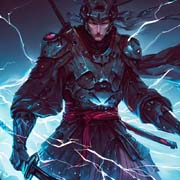
When the moon burns blue over a field of ragwort, a farmhand named Kira Talen finds a blade that remembers fire no living hand forged. She is messy and practical, bored by chores and tethered to a life of small, certain duties—until the weapon sings in her grip. The binding is sudden and absolute: the blade warms to her blood, hums with old promises, and marks her as something the fractured kingdom has not seen in generations. From the moment the moon first turns an impossible color, the path away from the furrow is forced upon her. Prophecy is not a polite invitation here; it is a claim.
The novel moves at a hard, relentless pace. There is no slow schooling in destiny—Kira learns by surviving. A raid on her village, a midnight test beneath a ruined stone temple, and a duel on a rain-slick cliff come one after another, each teaching her that swordwork is a conversation of immediate stakes: parries that breathe pain, openings that close with teeth or blade, and victories bought with cunning as often as brawn. Wounds ache; mistakes have consequence. Yet the hurt is balanced by awe—moonlight reveals sigils carved into living rock, night-birds sing in a tongue that remembers kings, and strange amphitheaters hum with memory.
Myth threads through the plot like silver thread through a cloak. The Moonforge that once bent lunar fire is gone, its kiln scattered. Embers and echoes remain—an ember lodged behind a waterfall, a whisper held in a river stone, an old smith who can still curl a crescent into a knife. When Kira draws the blade, it speaks with the aftertaste of a queen’s voice and the long, low warning of a god who sleeps beneath the sea. The weapon is not merely tool; it is a temperamental presence—luminous, hungry for purpose, quick to reward boldness and quick to punish pride. It complicates Kira’s sense of self: to carry the blade is to share each night with something that judges and comforts in equal measure.
The story leans into sword-and-sorcery energy: quick strikes, midnight heists for relics, rooftop chases beneath thunder, and ambushes inside ruined amphitheaters. Kira does not walk alone. She gathers a ragged, honest crew who are themselves learning to be more than the mistakes that marked them: a confident thief-scholar who reads broken dialects and hunts for the language that will unbind a curse; a cynical archer who wears loyalty like a rusted pin and hides a vow he won’t speak; a disgraced knight who still remembers how a stance can change a fight and how honor can be relearned. Their camaraderie is earned in the heat of survival—sharp banter, brittle trust, and forced reliance set against the larger sweep of prophecy.
- The runaway scholar — clever with lore, haunted by an oath to reverse curses, whose quick solutions sometimes risk too much.
- The cynical archer — humor masked as distance, deadly with a bow, sworn to a secret cause that complicates his choices with Kira.
- The disgraced knight — his armor is lighter in his pack than in his head; he teaches stances, strategy, and the cost of rigid codes.
Romance is suggested like moonlight on water—subtle, reflective, patient. Feeling grows not as a distraction from the task but as an added spine of care; it teaches Kira to protect not only power but those who cannot stand in court or fight politics. Bonds in the crew are complex: loyalty is tested, betrayals sting sharp, and forgiveness is often transactionally earned. Their interplay underscores the novel’s belief that growth is communal as well as personal.
Politics press at the edges of every skirmish. The kingdom itself is a map of old hurts: rival houses clutch influence, a star-crazed regent seeks to marry cosmic omen to human greed, and secret cults worship a night-god promising renewal through blood. Rumors of Kira’s lineage—talk that ties her to an ancient, moon-touched dynasty—both shield and expose her. For some she is hope, for others a threat to be extinguished. Each decision she makes ripples: a misstep can mean exile, the fall of a village, or the turning of a sleeping god into an angry force.
Details are tactile and immediate: the grit of a road underfoot, the metallic taste of fear before a duel, the cold burn of moonlight on skin when revelation arrives. The world remembers legends in whispers and in the bodies of old trees; mountains keep secrets in their roots and forest songs change pitch when strangers pass. Those textures keep wonder in balance with grit—mythic grandeur means nothing if your feet are blistered and your hands are raw with practice.
The plot tightens toward a compact, decisive climax beneath a moonstone once sacred but twisted into a weapon by those who would dominate fate. The final sequences are cinematic and fast: sword flashes, whispered bargains that weigh like anchors, and a reckoning where Kira’s choices reverberate beyond her band to touch villages, courts, and the sleeping sea-god who half-wakes. The blade demands stewardship that tests courage, compassion, and the capacity to choose differently than the past. Victory is earned and ambiguous—loss and hope coexist. The ending honors sacrifice and leaves room for the future to be remade.
Throughout, themes of identity and agency pulse beneath the action. Kira’s inheritance is not a neat destiny but an obligation she must learn to shape: to wield the blade is to inherit a promise and to decide how that promise bends in a world full of hungry politics and old hurts. She learns leadership from wounds and from quiet decisions to protect the vulnerable. The novel speaks to readers aged thirteen to seventeen who hunger for swift, intelligent prose, fights that test wits as well as arms, and a heroine who grows into power with both grit and grace.
Lean, rhythmic, and mythic, the tale asks hard questions while delivering the urgency of sword-and-sorcery adventure: What is inherited and what is chosen? Can a legacy of violence be transformed into stewardship? By the last moonlit page, Kira is no longer the farmhand who feared the world—she is the heir who has learned that holding a moonforged blade is to hold a promise, and that keeping promises might demand more courage than any duel.


BookZeta
Created on 2025-09-21 15:28:03Anthony Austin enjoys reading and writing stories on BookZeta
Recommended Stories

BookZeta
The Dragon In The Library
Oliver Finch never considered himself a fan of books, preferring the company of his imagination to the covers and pages of dusty old tomes. Yet, on one particularly dreary afternoon, when the rain pattered relentlessly outside, Ol...
Published On December 12th, 2025

BookZeta
The Moonberry Tree
In the tranquil village of Willowgrove, where nature itself hums with enchantment, young Tilly, a curious bunny, stumbles upon a wondrous secret hidden in the heart of the forest. On a night when the moon hangs full and bright, Ti...
Published On October 4th, 2025


JohnnyWordsmith
Crystals of Destiny: Journey Through Enchanted Realms
Crystals of Destiny: Journey Through Enchanted Realms Deep in the mystical lands of Vardalon, where legends live and nature is enchanted with the whispers of ancient magic, unfolds the epic journey of Aldyn, a brave apprentice wit...
Published On October 4th, 2025
Explore Our Visual Creations
Comics, graphic novels, and children's books brought to life with AI-generated artwork.


Please login to leave a review.
Reviews of The Moonforged Heir